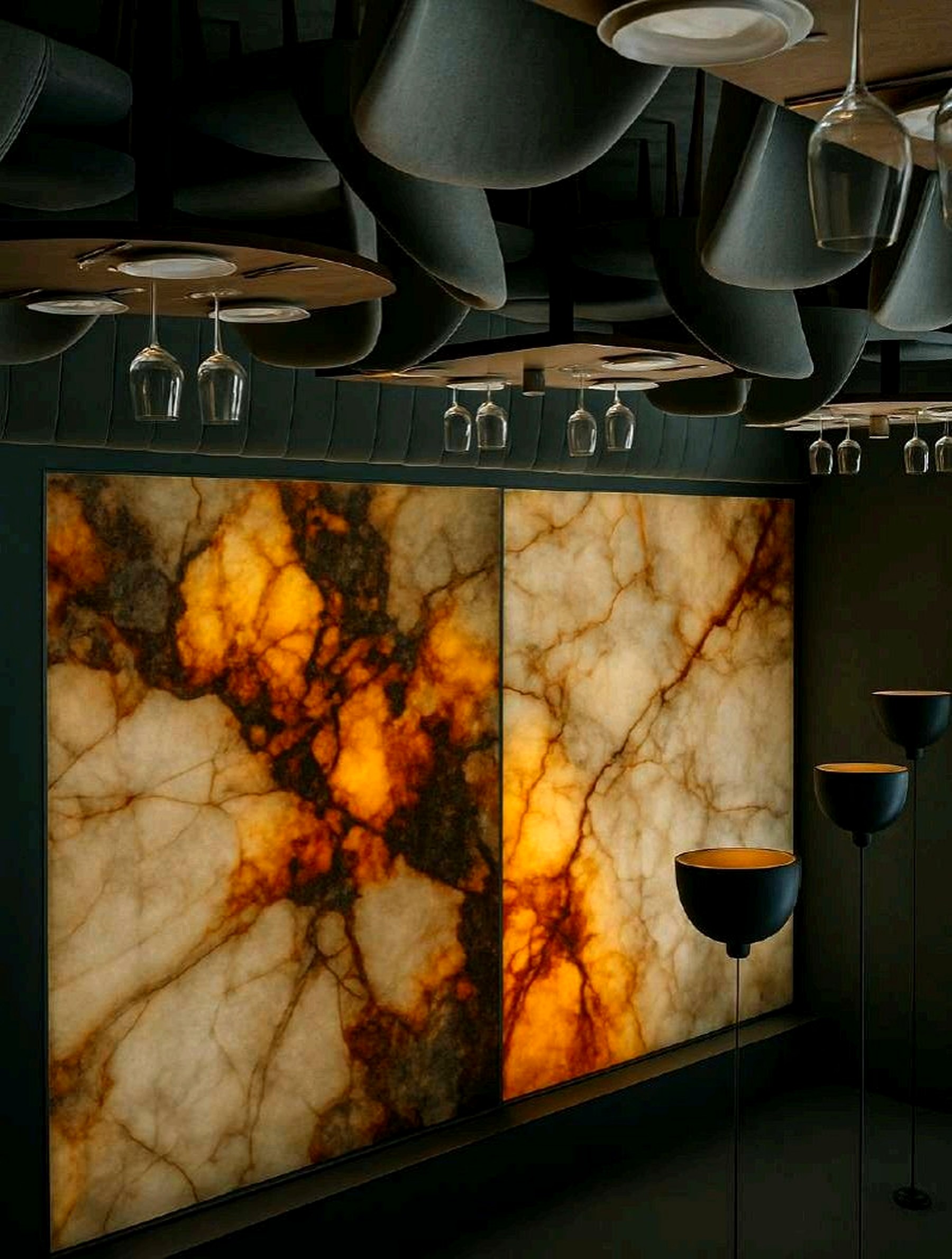
A media wall is the largest uninterrupted piece of stone most houses will ever have, and it is seen every evening under artificial light. That makes it the right place to spend on a dramatic stone: the screen is dark most of the time, and the wall around it is what the room actually looks at.
The strongest version is a bookmatched pair — two slabs opened like a book so the veining mirrors around a centre line, with the screen mounted over the join. Four-way matching, where four slabs mirror around a central point, is possible in most marbles and turns the wall into a single symmetrical figure. Both require the slabs to be reserved together from one block, so it has to be decided before cutting rather than after.
Backlit onyx is the other route. Onyx is translucent, and a 20 mm panel with an even LED field behind it glows from within rather than being lit from the front. It needs a cavity of around 80 to 120 mm for the light to spread without hot-spotting, diffusion between the LEDs and the stone, and access for lamp replacement designed in from the start. Get the cavity wrong and you see the individual diodes through the stone.
Practicalities: the wall has to carry the stone, so the substrate matters more than the stone does. Mechanical fixing is required over about 3 metres height, and all the services — power, HDMI, the screen bracket — must be positioned before the stone is cut, because nothing can be drilled afterwards without risk.
Specification at a glance
- Bookmatched pairs and four-way matched sets
- Backlit onyx with 80–120 mm cavity
- 20 mm slab, mechanically fixed above ~3 m
- Mitred returns at reveals and corners
- Cut-outs made before installation, not on site
- Slabs reserved from one block on request
Work out what you need
Send the elevation with the screen position and all services marked, and K2 will set out the slab matching around it.